This article presents the K-Challenge K3-H2 hybrid work boat project and highlights how Wattalps’ immersion-cooled battery technology enabled the development of a compact, high-power energy storage system for demanding maritime applications.
Context
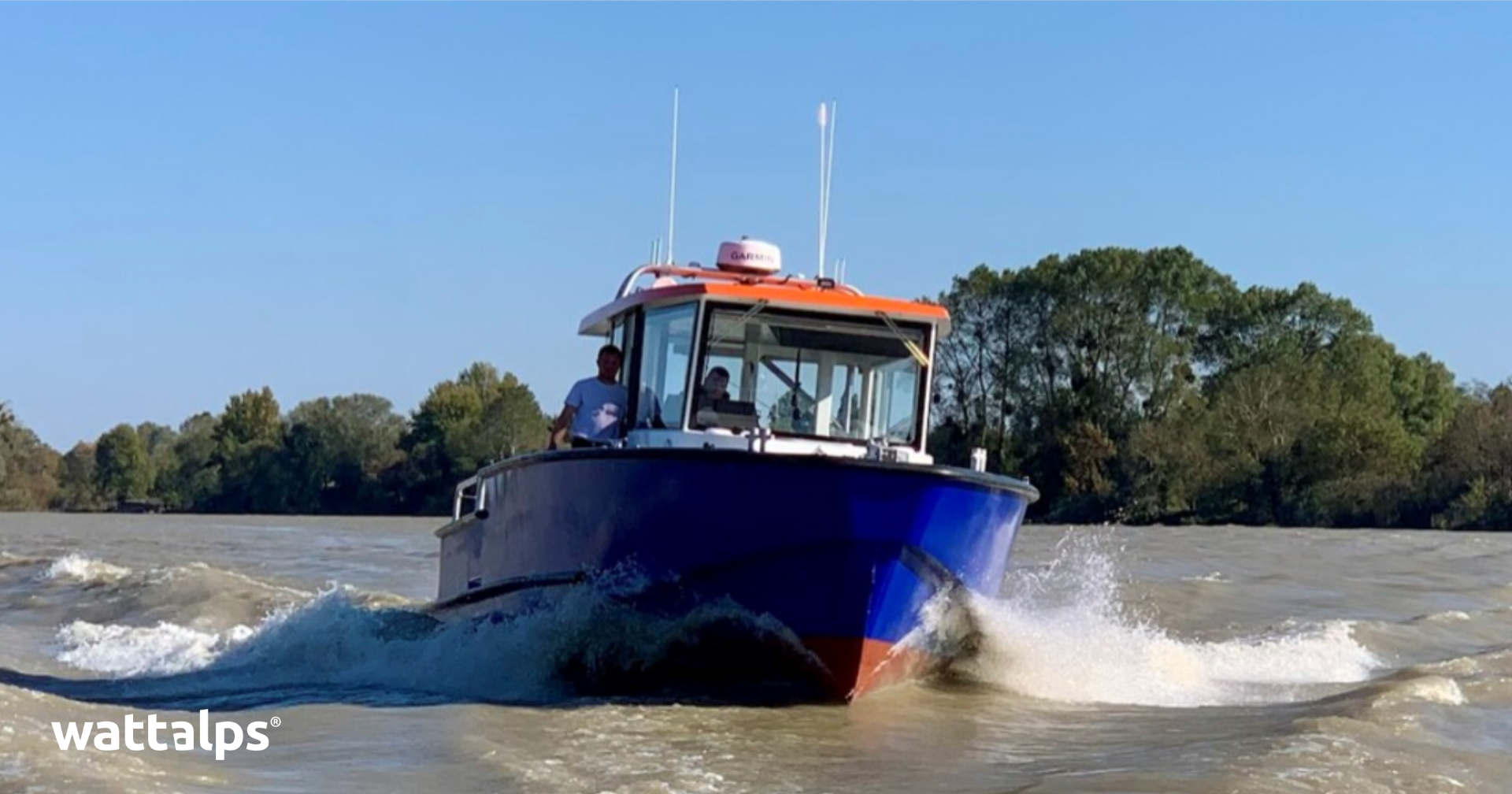
The K-Challenge K3-H2 project was launched to demonstrate a hydrogen-powered work boat capable of accelerating the decarbonization of maritime operations.
Supported by Région Bretagne and led by K-Challenge Lab with a consortium of maritime and hydrogen technology partners including Kinell, Weenav, Argo Anleg, Chantier Naval Delavergne Loire and Hopium, the project resulted in a next-generation 7-ton hybrid work boat combining fuel-cell and battery technologies.
Designed for demanding commercial operations including passenger transport, the vessel required an ultra-compact battery capable of delivering 180 kW of power from just 60 kWh of energy, while meeting Bureau Veritas marine certification requirements.
The challenge: Delivering 180 kW from a 60 kWh compact battery
The project team needed a battery system able to deliver:
- 60 kWh energy capacity
- 180 kW peak power (3C)
- 150 kW continuous power (2.5C)
- Marine Type Approval by Bureau Veritas
- Battery weight below 1 tonne
The challenge was not energy capacity since the vessel’s mission profile only required 60 kWh of energy.
The real challenge was delivering 180 kW of power from a compact 60 kWh battery without exceeding the temperature limits that negatively impact battery performance, safety, and lifetime.
When battery cells operate above 35°C for extended periods, ageing accelerates. Above 40°C, the impact on cell lifetime becomes severe. In high-power applications such as this one, thermal management therefore becomes a critical design factor.
The question facing the project team was then: how can a 60 kWh battery safely deliver 180 kW without overheating?
Why conventional cooling technologies fell short
Conventional marine battery technologies struggled to meet the power requirement while maintaining safe and homogeneous temperatures without dramatically increasing battery size and weight.
Air cooling
Air cooling offers limited heat transfer capability, resulting in significant temperature gradients within the battery pack.
Key limitations include:
- Up to 30°C temperature difference between cells
- Large installation footprint
- Additional air treatment requirements to prevent contamination
- Lower thermal efficiency
To meet the required power output, an air-cooled solution would have required a battery capacity of 180 kWh, tripling the energy storage actually needed by the vessel.
Water cooling
Water cooling improves thermal performance but introduces additional system complexity.
Its limitations include:
- Up to 14°C temperature difference between cells
- Additional weight and volume from cold plates
- Need for developing strong electrical insulation barriers between live electrical components and water
- Leakage risks requiring dedicated monitoring systems
- Additional cooling equipment, including chillers
Even with water cooling, the battery would still need to be oversized to 150 kWh to safely deliver the required power.
The WATTALPS Solution
WATTALPS addressed the thermal management challenge with its immersion cooling technology.
WATTALPS immersion cooling technology enables unrivalled thermal management
With WATTALPS technology, battery cells are immersed directly in a dielectric cooling fluid, ensuring highly efficient heat transfer and temperature homogeneity throughout the pack.
The patented technology delivers:
- Only 2°C temperature difference across the battery
- Uniform cell temperatures during high-power operation
- Improved battery lifetime
- Enhanced safety through efficient heat management and gas venting
- Simplified cooling architecture
Unlike conventional solutions, there is no need for a chiller dedicated to the battery and cooling can be performed using seawater as a cold source through a simple plate heat exchanger.
The immersion fluid also acts as a thermal buffer, absorbing power peaks and smoothing temperature fluctuations. This enables the cooling system to be sized according to average thermal loads rather than peak loads, further reducing system complexity and energy consumption.
Achieving a 3C discharge rate in a compact 60 kWh battery pack
Thanks to superior thermal management, WATTALPS made it possible to deliver the required 180-kW power output with the original 60-kWh energy target.
Where conventional technologies required significant oversizing, immersion cooling enabled the battery to be sized according to the vessel’s actual energy needs.
Battery sizing comparison:
| Cooling Technology | Battery Energy | Battery Power | Battery Weight | Cooling Power Required |
| Air Cooling | 180 kWh | 180 kW | 2 176 kg | 6 000 W |
| Water Cooling | 150 kWh | 180 kW | 1 246 kg | 8 000 W |
| WATTALPS Immersion Cooling | 60 kWh | 180 kW | 560 kg | 1 000 W |
This comparison highlights a key outcome of the project: WATTALPS was the only solution capable of delivering the required power from a 60-kWh battery.
Results: a lighter, simpler and more energy-efficient vessel
The benefits extended well beyond battery performance.
By eliminating battery oversizing, the WATTALPS solution reduced battery weight dramatically:
- 74% lighter than the air-cooled alternative
- 55% lighter than the water-cooled alternative
The simplified thermal management architecture also enabled:
- No battery chiller
- Easier integration into the vessel
- Reduced installation space
- Lower auxiliary power consumption
- Simplified overall vessel design
The impact on vessel operation was equally significant.
Compared with conventional solutions, the optimized battery architecture delivers:
- 13% to 25% lower energy consumption
- € 6 800 to € 13 000 annual fuel savings
- Equivalent to € 113 to € 216 savings per installed kWh per year. The total WATTALPS battery price is fully reimbursed long before the end of its life by the fuel saving it provides versus other batteries.
Conclusion
For this innovative hybrid work boat, the challenge was about extracting high power from a compact battery without compromising safety, lifetime, or efficiency.
Conventional cooling technologies could only meet the 180 kW power requirement by oversizing the battery to 150–180 kWh, adding significant weight, complexity, and operating costs.
By maintaining a temperature difference of just 2°C across the battery pack, WATTALPS immersion cooling enabled the project team to achieve the original 60 kWh target while delivering the full 180 kW power requirement.
The result is a lighter, more efficient vessel with simplified integration, lower operating costs, and a vessel architecture that would not have been achievable with conventional cooling technologies.
Learn more on: