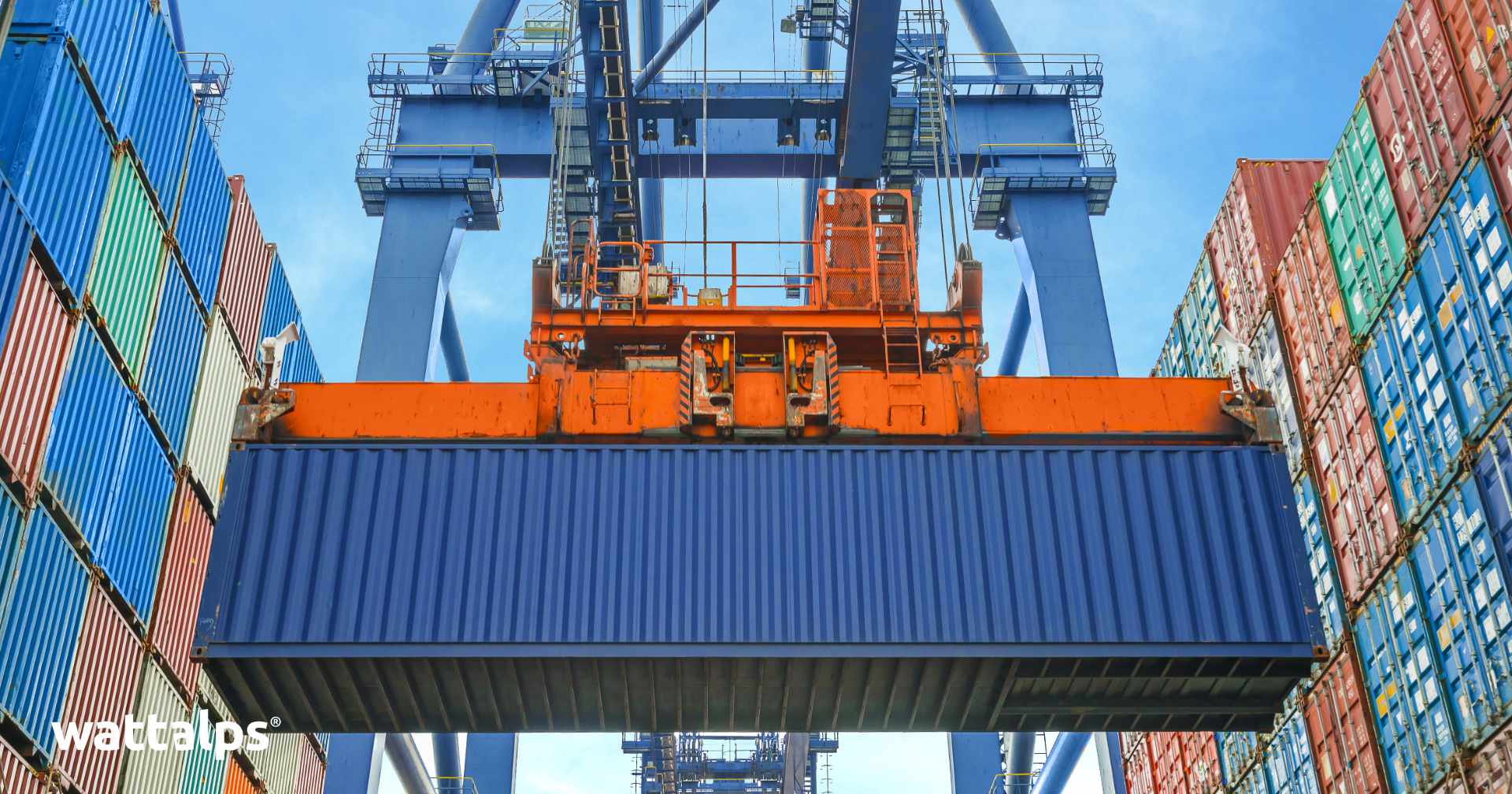
This article presents a case of port crane hybridization with WATTALPS battery systems, highlighting the challenges that were addressed and detailing the benefits, both operational and financial, obtained with the selected solution.
Context
A major system integrator in the port industry was looking to modernize and retrofit high‑value port cranes for a large port operator. These cranes are expensive assets that must operate for long periods with minimum downtime.
They were powered by large diesel engines that are costly to run and maintain, and these engines needed to be retrofitted to extend the cranes’ lifetime.
At the same time, ports operate in an industry facing increasing pressure to reduce emissions and costs.
Challenges
Why move to electric
- Operational productivity: the existing diesel engines were oversized to handle short peak‑power events (≈5% of operating time at 5 to 10 times the average power), leading to inefficiency 95% of the time.
- High energy costs: the energy cost per container moved was high due to inefficiency and rising fuel prices.
- Environmental constraints: diesel engines generate high fuel consumption and high emissions.
Therefore, electrification was identified as a key option to address the above challenges.
Hybridization as a practical alternative to full electric
Full electrification is not feasible for many ports because it requires major electrical infrastructure upgrades that many terminals cannot install. As a result, ports worldwide are exploring hybridization as a practical alternative to full electrification.
With hybrid cranes, energy is recovered by the battery during container descent and then reused during lifting, thereby avoiding the need for infrastructure upgrades and eliminating battery charging downtime.
The battery is mainly used for peak-shaving, enabling significant downsizing of the diesel engine.
Battery constraints for hybrid cranes
Hybrid cranes require batteries capable of very high charge and discharge rates, while providing also enough energy for long peaks of power. Conventional batteries must be oversized to deliver peak power, increasing cost and integration complexity. Therefore, our customer was looking for a compact battery system that could deliver high power and long life, while remaining modular and easy to deploy.
A battery with marine type approval was also required to reassure the port operators on the safety of the system.
WATTALPS Solution
WATTALPS offered a 60-kWh high‑power battery system capable of providing 300 kW of peak power with a 10‑year lifetime. WATTALPS immersion cooling technology combined with the system’s compactness and robustness makes it ideal for hybrid crane applications where power density and durability are critical.
WATTALPS batteries have received maritime type-approval by Bureau Veritas.
Results
Compared to the existing diesel‑only solution
- 55 to 70% fuel savings thanks to downsizing the diesel engine to 90 kW.
- Reduced maintenance costs due to smaller engine.
- The return on investment is in 0.7 to 2 years depending on fuel price (0.8 to 1.3€/L) and on the number of retrofitted cranes to amortize the associated engineering cost, meaning huge savings over 10 years of 5 to 10 times the initial investment.
- Two‑thirds reduction in emissions.
- Increased productivity linked to 55% to 70% reduction in refueling time.
Compared to a liquid‑cooled LTO battery
An LTO system would require 40.5 kWh to match WATTALPS performance. WATTALPS solution provides 30% lower CAPEX for the same power and lifetime, since LTO is significantly more expensive and not as well cooled.
Compared to an air‑cooled LFP battery
To achieve the same power and 10‑year lifetime, an LFP battery system would need to be oversized to 267 kWh, in which case WATTALPS CAPEX is 30% lower. Or a 145 kWh LFP system could deliver the same power but would need replacement after 3–5 years.
WATTALPS delivers a 57% lower TCO thanks to longer lifetime and no battery renewals. Downtime costs for battery replacement are not included — which would further increase the WATTALPS advantage
Conclusion
By adopting WATTALPS immersion cooling battery technology, our customer and the port operator achieve:
- Major reductions in fuel consumption and operating costs
- Significant cuts in CO₂ and particulate emissions
- Improved crane availability and productivity
- A practical hybrid solution without requiring heavy electrical infrastructure
- A certified, compact, modular, long‑life battery system optimized for demanding port operations
Learn more on: