Interview with Matthieu Barbier, Technical Manager at Hyliko.
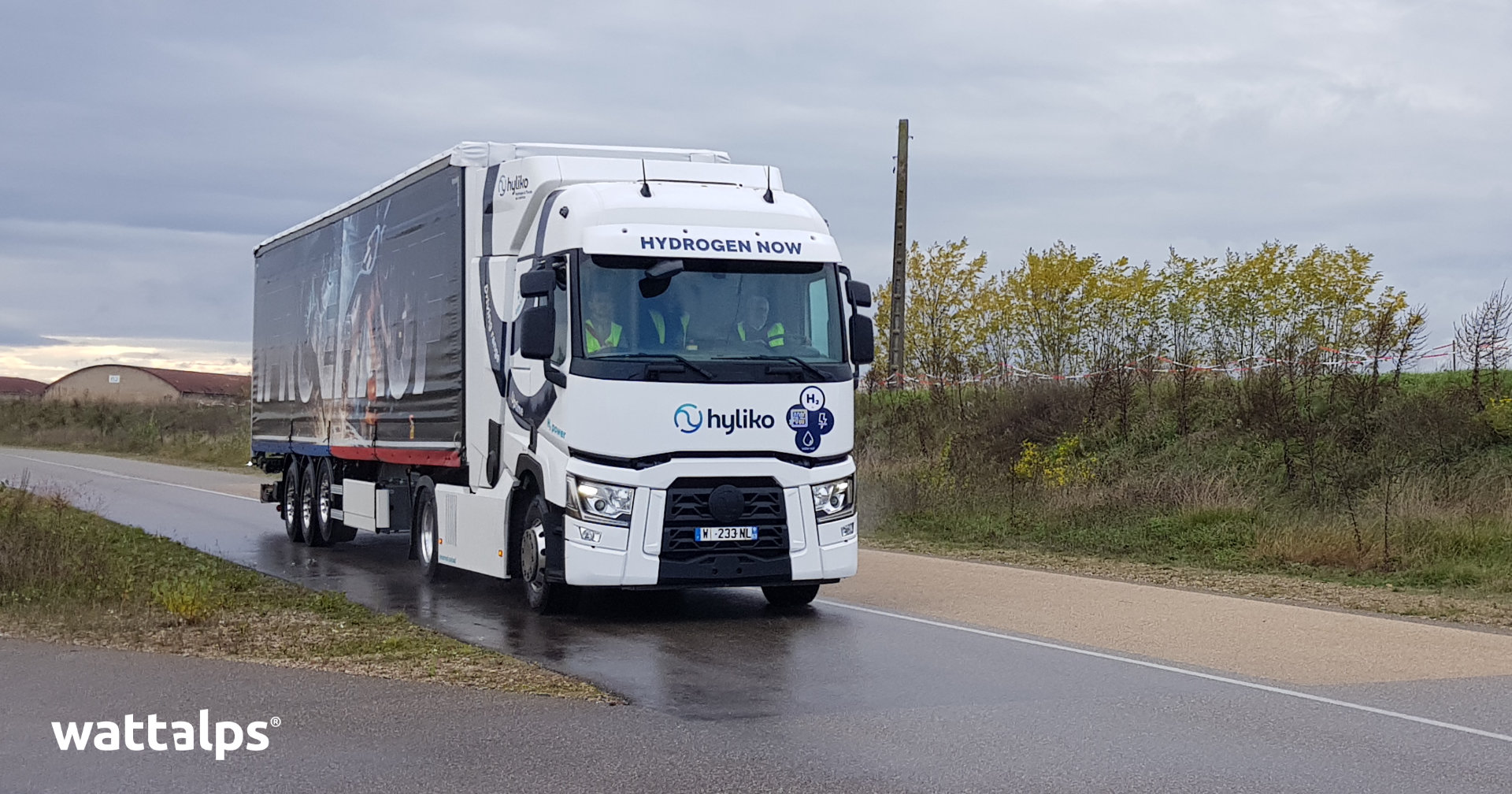
In this testimonial, Matthieu Barbier presents Hyliko’s new generation of hydrogen retrofit heavy trucks integrating WATTALPS batteries, highlighting the challenges faced, the reasons for choosing WATTALPS technology, and the resulting benefits.
Hyliko recently launched a new generation of hydrogen fuel cell heavy-duty trucks. Could you tell us more about this innovation and what benefits it brings to your customers?
This is our second generation of vehicles, representing a significant evolution from the first generation released in 2023. This new generation features a more modular architecture, along with major improvements in weight, efficiency, and therefore energy consumption.
These enhancements result in a roughly 25% increase in driving range compared to the first generation, as well as reduced manufacturing costs. All key components have been redesigned and redeveloped to better meet users’ needs.
This modular approach allows us to tailor each vehicle configuration very precisely to its specific use case. Whether it is a 44-ton heavy-duty truck, a 26-ton crane flatbed truck, or vehicles operating in mountainous areas or on flat terrain, we can adjust the different modules to deliver optimal performance.
Among these modules, the battery developed with WATTALPS plays a key role. It has been specifically optimized to improve the vehicle’s overall efficiency and to ensure a solution that is perfectly suited to each customer’s operational requirements.
“These enhancements result in a roughly 25% increase in driving range
compared to the first generation”
These new heavy-duty trucks are equipped with high-performance batteries. What are the main challenges when integrating batteries into vehicles like yours?
Batteries are at the core of the electrical architecture, particularly the high-voltage system, with vehicles operating in the 600 to 800 V range.
Several key challenges must be addressed when integrating batteries. First and foremost, safety is critical. This includes managing risks related to side impacts, as well as fire hazards and thermal runaway, which are central concerns when working with high-energy battery systems.
Integration is another major challenge. Designing batteries that can be seamlessly incorporated into the vehicle while maintaining performance, safety, and space efficiency requires significant engineering effort. Clear and well-defined interfaces between the battery and the rest of the vehicle systems are crucial to ensure reliability, ease of integration, and overall system efficiency.
Modularity is also essential. It enables us to adapt battery configurations to different vehicle types and use cases, while ensuring optimal performance.
Why did you choose WATTALPS batteries?
There are several reasons behind our choice of WATTALPS.
Safety was a key factor in our decision. WATTALPS batteries use an immersion cooling technology, where the cells are immersed in a dielectric liquid. This prevents thermal runaway and keeps the cells at a stable temperature, typically around thirty degrees, ensuring very balanced performance.
These are high-power batteries designed to handle significant power peaks, which naturally generate heat. The thermal management system surrounding the cells ensures temperature homogeneity and optimizes their lifespan. This is critical in our case, as our vehicles are designed to last at least 10 years and cover a minimum of 1 million kilometers. The cells must therefore be able to perform reliably over this entire lifecycle.
Another reason for choosing WATTALPS batteries is their modular design which is perfectly aligned with our approach to vehicle customization and scalability.
We have also integrated a fully optimized cooling system, validated the interfaces, and leveraged a highly modular “lego-like” architecture. In addition, the external cooling system contributes to protecting the cells in the event of a lateral impact.
These batteries are optimized, clean in design, and based on a simplified architecture, including streamlined fluid circuits and a dedicated integration zone within the vehicle.
“The thermal management system surrounding the cells ensures
temperature homogeneity and optimizes their lifespan. This is critical in our case, as our vehicles are designed to last at least 10 years and cover a minimum of 1 million kilometers“
Can you tell us more about your collaboration with WATTALPS and how it all started?
We first had technical discussions about battery architecture. For the first generation, we were not mature enough and we didn’t have enough time, given the Olympic Games deadline, to integrate WATTALPS’ technology with full risk control.
We later got back in touch with WATTALPS because there were quite a few issues with the first generation. We learned a lot from that first architecture and valued it optimize capacities through customer application with a new breakthrough technology. Immersion technology is very interesting in terms of weight, energy density, and safety, especially for end-user applications. So we re-established contact.
The technical relationship with WATTALPS is very detailed and precise, which is highly appreciated by the teams. We worked together to turn the concept into a real solution. Once the concept was validated, we confirmed the collaboration. We clearly identified the value for the end user, and WATTALPS then developed this immersed battery system for our heavy-duty vehicles.
We have built a close and trust-based collaboration with WATTALPS. We work directly with their experts, maintain a strong technical understanding, and benefit from their deep knowledge of real-world usage.
This partnership and know-how have enabled us to fully integrate this key technological building block and have a high level of confidence in how we use it. This allows us to deploy to customers a vehicle that is safe, robust, with the right redundancies, modular, and optimized for customer usage.
Are you able to quantify the gains delivered by WATTALPS batteries?
“We reduced battery weight from around 700 kg to 400 kg“
Safety is absolutely critical for us, especially when transporting hazardous materials. For example, when carrying hydrogen, we cannot afford any risk of battery ignition. As explained, WATTALPS immersion cooling technology and battery design ensure temperature control and homogeneity, and prevent thermal runaway. The batteries are certified according to R100 rev 5 homologation.
Lower weight: We reduced battery weight from around 700 kg to 400 kg, freeing up space and enabling the integration of additional auxiliary systems.
No need for a separate cooling unit: Thanks to the highly efficient cooling technology, there is no need for an additional refrigeration system.
Reduced energy consumption: With lower weight, no extra cooling unit and optimized regenerative braking, the system helps lower the vehicle’s overall energy consumption.
Range increase: As mentioned, our new generation of hydrogen fuel cell heavy-duty trucks gains a 25% increase in range compared to the first generation.
Improved overall efficiency: The batteries have very low internal resistance, which contributes to higher efficiency while ensuring a lifespan of 10 years and up to 1 million kilometers.
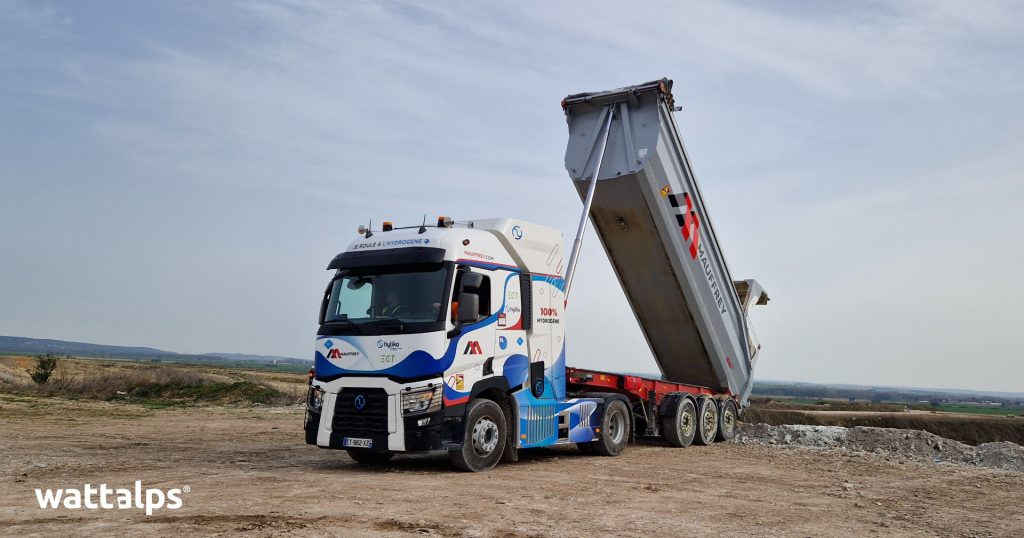
Photo credit: Hyliko et ECT.