Introduction
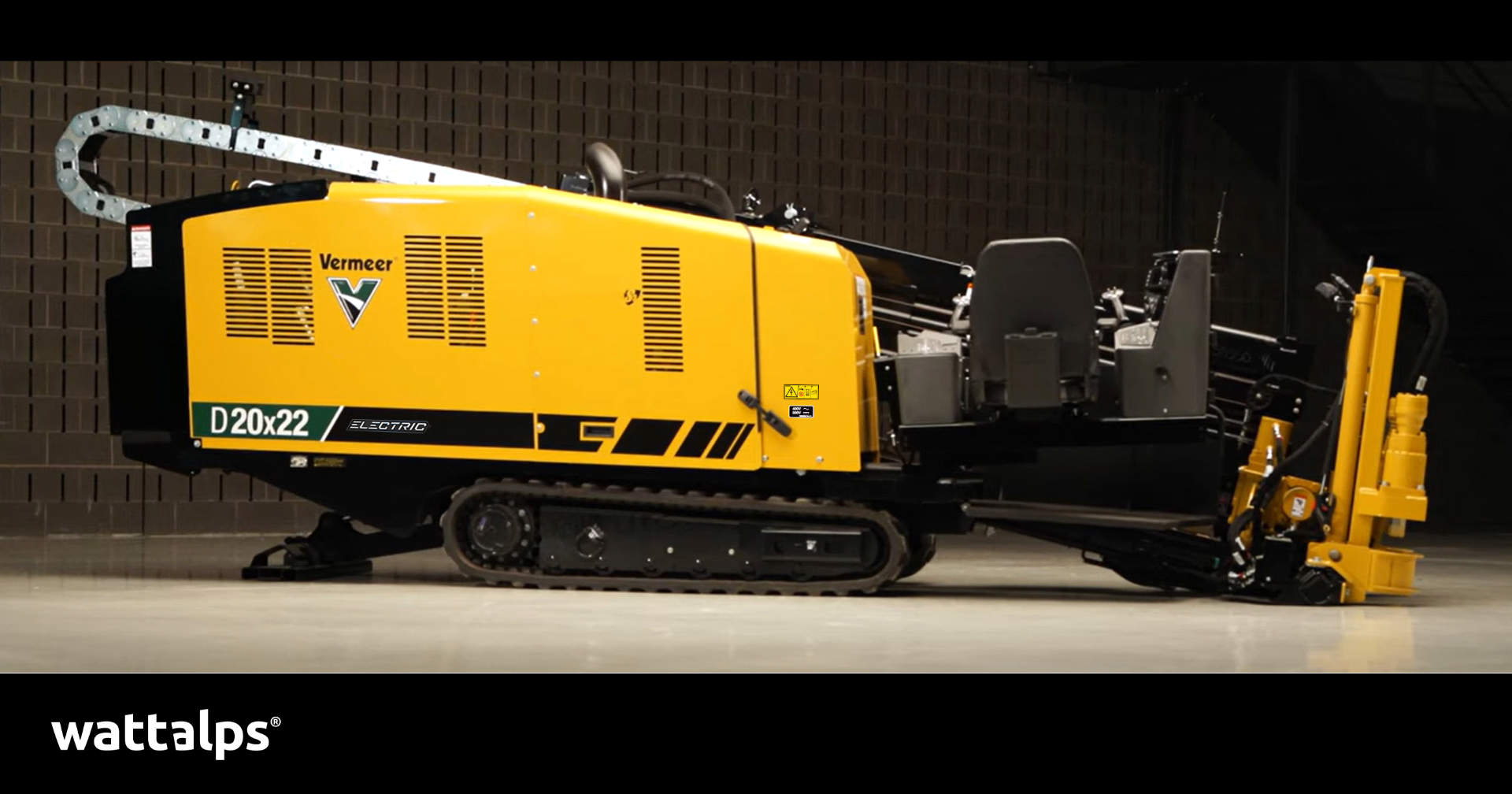
This application note outlines the selection, integration, and validation of a high-voltage battery system for a plug-in battery electric directional drill (PBEV). The project, a collaboration between WATTALPS and VERMEER, focuses on adapting advanced battery technology to meet the demanding requirements of horizontal directional drilling (HDD) across diverse soil conditions.
Application context
The Vermeer directional drill operates in a wide range of ground conditions (hard soil, cobble, medium soil, loam, soft rock, sandy soil, and soft soil) in extreme temperatures (up to 49°C ambient temperature).
The battery system had to match the following average workday and duty cycle requirements:
- Tracking (30 min): Battery only
- Short bores: Battery only
- Normal work: Plugged-in + battery
Battery selection & validation campaign
WATTALPS provided a modular, 800V, 21 kWh battery pack featuring a patented immersion cooling system. This system ensures optimal thermal management and performance under extreme conditions.
A comprehensive validation campaign was conducted by WATTALPS to ensure the battery system meets the rigorous demands of HDD applications:
- Mechanical and environmental testing: vibration endurance, mechanical integrity, fire resistance, over-voltage, over-current, and overheating protection, high-pressure water jet, water immersion, and salt spray resistance
- Thermal and EMC testing: thermal performance under high ambient temperature sup to 45°C, cold start capability down to -20°C, EMC compliance with standards including EN 55011 and IEC 61000 series
Lessons learned
Smart balancing strategy
Traditional balancing at the end of charge is incompatible with continuous operation in plug-in mode. To reduce machine downtime, WATTALPS implemented a dynamic balancing strategy where automatic balancing is done during rest periods, regardless of battery state.
Besides, since balancing is due to differential aging, WATTALPS addressed the causes of differential aging by implementing a drastic selection of high-quality cells only, by optimizing the battery design so that all cells provide the same current, and are at the same temperature thanks to its patented immersion cooling technology.
BMS insights – High dynamic load handling
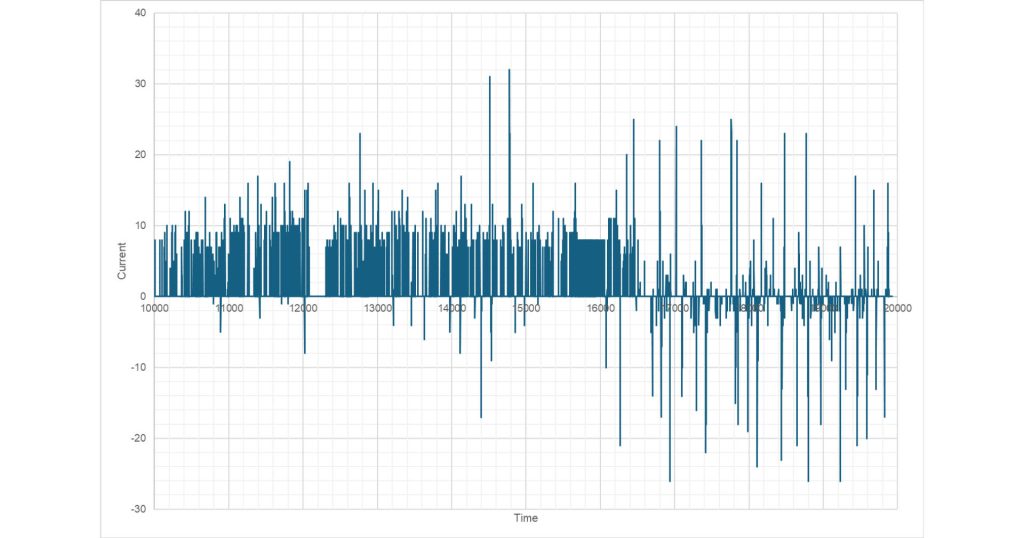
Drilling effort varies rapidly due to changing soil hardness. With its double cell voltage monitoring system, the WATTALPS BMS has been adapted to handle high current variation and avoid false voltage readings.
Battery learning & integration
In the first prototype setup, the battery cooling was in the same loop as the rest of the powertrain, which led to too high coolant temperatures for the battery. A dedicated thermal management with a small liquid-to-air radiator dedicated to the battery was implemented with success. The communication protocol was updated to be compatible with J1939. Battery mounting and heater configuration were optimized. Electrical noise mitigation strategies were implemented.
Heat & cold start testing
The testing in very hot conditions (45°C) showed that the battery, even for highly demanding work conditions, did not overheat. Indeed, the high thermal capacity of the coolant combined with that of the battery enabled the battery cells to stay below the ambient temperature for most of the temperature peak during the day. When the cells temperature got higher than the ambient temperature, the air cooler was efficient enough to maintain the cells temperature below their derating threshold, enabling seamless work at high performance.
In cold start conditions, the system power requirements increase for the same output whereas cells performance is lower at low temperatures. To cope with this situation, the battery is equipped with a heater, which can be activated at the machine startup and heat up the battery quickly to its optimal working temperature. Once at this temperature, the machine can work seamlessly at full performance. With WATTALPS batteries, it is more efficient to do so since the energy needed to heat up the battery is smaller than the capacity loss at low temperatures. And this energy can advantageously be taken from the grid when the driller is connected with its cable.
Project timeline
Launched in Spring 2024 after one year of test mule development, the project started with prototypes and base pilots. Thermal, EMC, lab and field testing were carried out in the summer of 2024. Completion of pilot testing in Europe was done in Fall 2024 and the product was launched in 2025 with first customer field feedback collection.
Conclusion
The integration of WATTALPS’ high-voltage battery system into Vermeer’s directional drill demonstrates the feasibility and performance of PBEV solutions in demanding construction environments. Through rigorous validation and innovative design strategies, the project sets a benchmark for electrification in heavy-duty applications.
Learn more on WATTALPS battery systems